
Call for Contributions:
EBSN Annual Conference 2026
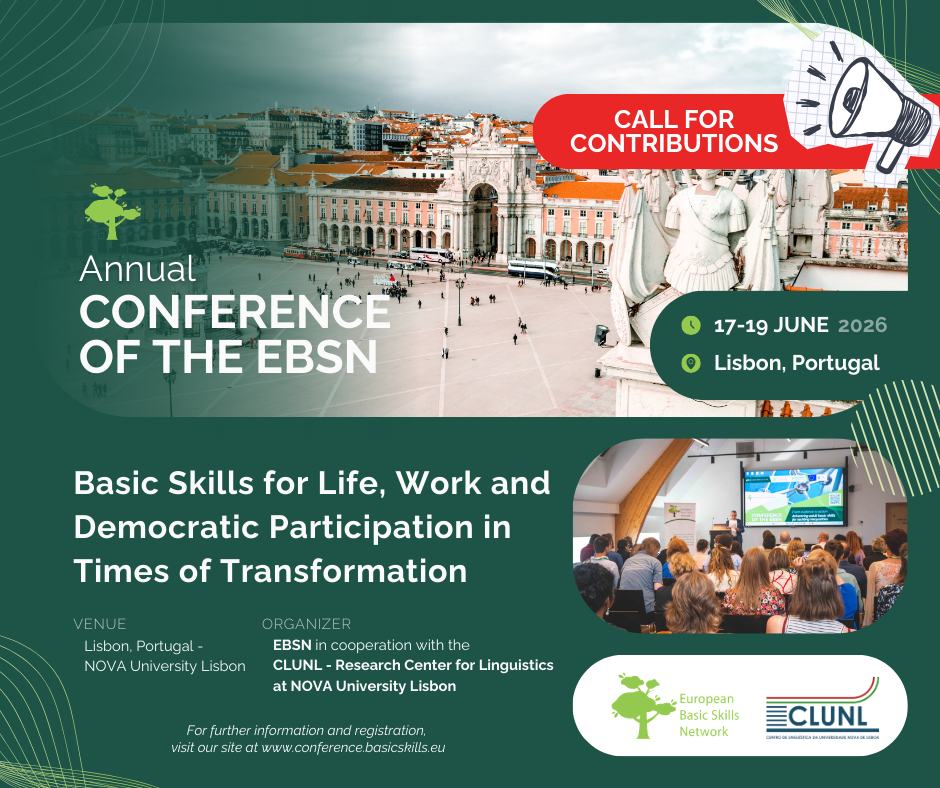
The Conference Programme Committee is pleased to invite proposals for contributions to the Annual Conference of EBSN, scheduled for June 17-19, 2026, in Lisbon, Portugal.
Following requests from several colleagues, the submission deadline has been extended to 6 April 2026.
FORMAT
In-person
Extended deadline
6 April 2026
NOTIFICATION OF ACCEPTANCE
15 April 2026
Invitation
The Conference Programme Committee is pleased to invite proposals for contributions to the EBSN Annual Conference & General Assembly 2026, hosted by NOVA University of Lisbon, taking place in Lisbon (Portugal), 17-19 June 2026.
Under the theme “Basic Skills for Life, Work and Democratic Participation in Times of Transformation”, the conference will bring together policymakers, practitioners, researchers, and stakeholders to exchange evidence, innovations and actionable approaches that strengthen adults’ foundational skills-so people can navigate everyday life, adapt in the labour market, and participate meaningfully in democratic societies.
Why this theme now?
Europe is facing overlapping transitions-digital and AI-driven change, labour market restructuring, demographic pressures, and rising concerns about democratic resilience in the context of disinformation and polarisation. In this context, basic skills are not a “nice to have”: they are a prerequisite for accessing services and rights, progressing in work and learning, and participating in civic and democratic life.
The urgency is underlined by the latest OECD PIAAC results, which highlight persistent skills gaps and inequalities among adults. In response, EBSN and EAEA have called for a stronger commitment to lifelong and life-wide learning and for more coherent governance and investment to ensure adult learning systems can reach those most excluded-captured in the message that ‘PIAAC demands action’.
This agenda is closely aligned with major EU priorities, including the Union of Skills and the Action Plan on Basic Skills, which emphasise the need to strengthen foundational skills across literacy, numeracy, digital and citizenship domains as a basis for competitiveness, social cohesion and democratic resilience. While recent initiatives have renewed attention to basic skills, policy focus and resources continue to prioritise children and schooling, leaving many adults insufficiently supported. The Conference therefore places adult basic skills firmly at the centre, focusing on what works-at national, regional and local levels-to strengthen adults’ opportunities for life, work and meaningful democratic participation in times of transformation.
What we are looking for
EBSN invites proposals that advance policy-level dialogue and mutual learning, while also showcasing innovations that can strengthen adults’ basic skills for life, work and democratic participation. The conference is designed as a space where decision-makers, practitioners and researchers can jointly examine what the evidence suggests, what works on the ground, and what needs to change in systems, funding and delivery.
We welcome contributions from:
- Public authorities and agencies (EU, national, regional and local) working on skills, employment, social inclusion, integration, digitalisation, culture/media, citizenship and participation (including also the National Coordinators for Adult Learning, ESF+ Managing Authorities and Erasmus+ National Agencies).
- Adult learning and basic skills providers, guidance services, community learning centres, and practitioner networks.
- Researchers and universities, observatories, and data/policy analysis teams working with skills evidence (including PIAAC and related research).
- Social partners and labour market actors, including employers, chambers, sector bodies, Public Employment Services (PES) and workplace learning providers.
- Civil society organisations and community actors working with underserved groups, and supporting outreach, inclusion, and participation.
- Projects and innovators (including EU-funded initiatives) developing new tools, approaches and partnerships for outreach, learning design, digital inclusion and system improvement.
We particularly encourage contributions that reflect collaboration across these stakeholder groups.
In times of accelerating transformation, skills needs and gaps can emerge faster than traditional policy cycles. The Conference aims to strengthen the “action chain” from evidence → to public understanding → to policy design → to implementation capacity, ensuring that adult learning and basic skills provision are visible, credible, and policy-relevant. Proposals should explicitly indicate where they contribute within this ‘action chain’.
The Conference is designed to strengthen learning and exchange between policy, practice and research, supporting more agile responses to emerging skills needs. It aims to create a space where policymakers, practitioners and researchers can jointly examine what works in practice-helping actors identify early signals, test approaches, adapt quickly and scale effective solutions. Therefore, the conference will prioritise interactive formats that encourage dialogue between policy, practice and research.
Importantly, this includes contributions that develop and strengthen the evidence base of adult basic skills provision through practice and implementation. We therefore particularly welcome proposals that examine how evidence is generated and used in real learning contexts-such as through professional development for educators, innovative teaching and learning approaches, instructional design, learner assessment, learner support systems, pilot evaluations, and implementation research.
Parallel sessions and the marketplace should therefore move beyond describing challenges by highlighting what can be scaled, transferred or adapted, and which mechanisms (governance, funding, partnerships, workforce capacity, data use) enable successful scaling up and sustained impact.
(The conference aims to reflect a balanced mix of countries, stakeholder perspectives and sub-themes, and to support cross-country learning among policy makers and stakeholders.)
Sub-themes
Contributions should relate to one (or more) of the following sub-themes:
1.
Basic skills as a foundation for democratic participation
Digital citizenship, media and information literacy, participation in and inclusion within democratic processes.
2.
Basic skills for private life, public services, family and community
Access to services and rights; navigating everyday life; health, financial and administrative literacy; supporting learning in families; community-based approaches; low-threshold provision and outreach grounded in real-life contexts and responsive to adult learners’ needs.
3.
Basic skills for the workplace in transition
Workplace basic skills, upskilling pathways, guidance, validation, micro-credentials, sectoral and employer-based approaches.
4.
Equity and inclusion in times of transformation
Reaching underserved groups and communities (e.g., low-qualified adults, migrants, rural or remote learners, older adults, people in vulnerable situations); trust-building, destigmatisation, sustained participation and progression; inclusive outreach strategies grounded in the lived realities of adult learners.
5.
Teaching, learning design and digital inclusion
Learner-centred methods and personalisation of learning, blended and hybrid models, educator professional development, digitally supported learning; opportunities and risks of AI-supported learning, responsible, ethical and transparent integration of AI-based technologies, approaches to assessing learning outcomes and strengthening the evidence base of adult basic skills provision.
6.
Governance, systems and cross-sector collaboration
Coordination across ministries and levels; enabling frameworks and funding; learning cities and local ecosystems; partnerships across sectors; community-based learning; delivery models that connect skills evidence to implementation and demonstrate lessons learned and learner progression; mechanisms for monitoring impact, supporting data-informed improvement, and enabling sustainable scaling of effective approaches.
Contribution formats
The EBSN Annual Conference 2026 will include plenary sessions, parallel sessions and a marketplace.
Plenary contributions should provide a clear, strategic message relevant to the overall conference theme and stimulate reflection across countries and stakeholder groups. Proposals for plenary sessions are expected to offer one or more of the following:
- high-level policy perspectives or strategic analysis;
- synthesis of evidence or cross-country comparative insights;
- systemic innovation with demonstrated relevance beyond a single context;
- forward-looking reflections that inform European or national policy development.
Format: 15 minutes presentation + 5 minutes Q&A.
For plenary proposals, please include:
- a short rationale explaining the strategic relevance to the overall theme;
- a clear outline of key arguments or findings;
- the main message or takeaway for the audience;
- indication of how the contribution advances European policy or cross-country learning.
Parallel sessions are the core interactive space of the conference and are designed to generate conclusions and recommendations for action.
Each parallel session will last 25 minutes and should:
- introduce the topic or challenge in up to 15 minutes;
- facilitate an engaged and structured discussion for the remaining time;
- aim to produce clear insights and actionable conclusions relevant to policy and/or practice.
To support meaningful exchange, proposals should clearly describe:
- the wider relevance of the topic (why it matters now);
- 2-3 reflective questions to guide discussion;
- the facilitation approach (how participation will be encouraged and made inclusive);
- how outcomes will be captured (e.g., short synthesis, action points, recommendations).
Parallel sessions should be designed to produce concise, conference-ready conclusions that can inform policy and practice at EU, national or local level.
Marketplace contributions should be designed for active engagement with participants (e.g., demonstrations, hands-on try-out, guided mini-dialogues, interactive resources), not only passive display. A desk will be provided by the organisers, displaying digital content should be ensured by the exhibitors. Practical details (table size, power, set-up times) will be shared with accepted contributors.
Marketplace proposals must include:
- what participants will engage with (tool/method/resource/project)
- how interaction will be facilitated
- expected takeaways for participants
Submission Guidelines
What to submit
All proposals should include:
- title, author(s) and organisation(s)
- preferred format (plenary / parallel / marketplace)
- selected sub-theme(s)
- short abstract describing purpose, relevance and key messages
- the submission form includes a structured template (Part II) to support interactive session design and action-oriented outcomes.
How to submit
Proposals must be submitted via the online submission form available on the forms.
Review and selection
Proposals will be reviewed by the Conference Programme Committee based on:
- relevance to adult basic skills, to the overall conference theme and sub-themes
- clarity and focus of the proposal
- strength of the rationale, credibility of the proposal and transferability of insights
- potential to stimulate discussion and learning between participants
- for parallel sessions: strength of the interactive design and the plan to produce conclusions and recommendations for action
- balance across sub-themes, countries, and stakeholder perspectives
Key dates
Extended deadline
6 April 2026
Notification of acceptance
15 April 2026
Conference dates and venue
17–19 June 2026, Lisbon (Portugal)
Important Notes
- Language: English.
- Costs: presenters are responsible for their own travel and accommodation.
- Conference fee: 290 € – for EBSN members, preliminary members and accepted presenters (representing non-member organizations).
- Publication: accepted titles and abstracts may be published on the conference website/programme.
- Accessibility: participants with access needs are invited to contact the Secretariat.
- Recording/photos: information on photography/recording will be shared with registration details.
