
Call for Contributions:
EBSN Annual Conference 2027
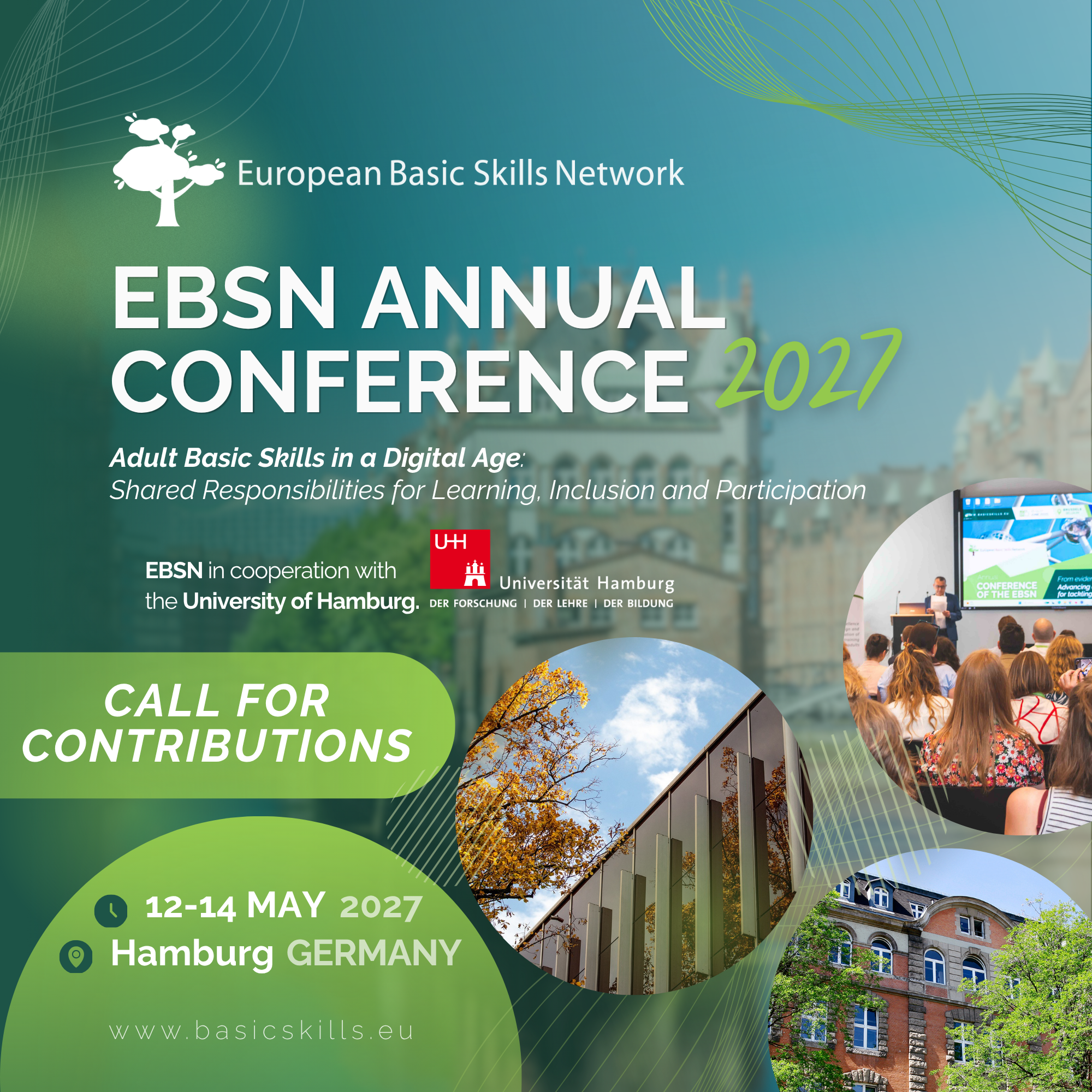
The Conference Programme Committee is pleased to invite proposals for contributions to the Annual Conference of EBSN, scheduled for 12-14 May 2027, in Hamburg, Germany.
FORMAT
In-person
Submission deadline
11 January 2027
NOTIFICATION OF ACCEPTANCE
1 February 2027
PARTICIPATION
Open to EBSN members and non-members
CONFERENCE COMPONENTS
Pre-conference programme and networking, EBSN General Assembly, plenary sessions, interactive workshops, facilitated parallel sessions, and Marketplace / Practice Exchange.
Invitation
The Conference Programme Committee invites contributions to the EBSN Annual Conference & General Assembly 2027, hosted in Hamburg in cooperation with the University of Hamburg from 12 to 14 May 2027.
Both EBSN members and non-members are warmly invited to participate in the conference and submit contributions.
Under the theme “Adult Basic Skills in a Digital Age: Shared Responsibilities for Learning, Inclusion and Participation”, the conference will bring together policymakers, practitioners, researchers, providers, employers, educators, civil-society organisations and other stakeholders to examine how adult basic skills can be strengthened in rapidly changing and increasingly diverse societies.
The conference seeks contributions that move beyond describing problems or simply reporting on projects. This includes contributions exploring how digitalisation and AI are reshaping basic skills needs, learning opportunities and participation. We are particularly interested in evidence, practical experience and policy approaches that clarify what enables adults to learn, use and sustain basic skills; who carries responsibility for creating these conditions; and how effective responses can be transferred, adapted or scaled. Contributions should stimulate active exchange and help participants identify practical lessons for their own contexts and, where relevant, implications for policy development and implementation.
Contributions addressing non-digital dimensions of adult basic skills are equally welcome, particularly where they illuminate changing responsibilities for inclusion, participation and learning.
Why this theme now?
Recent international evidence confirms both the scale and persistence of the challenge. The OECD’s 2026 analysis of the Survey of Adult Skills reports that nearly one in three adults across OECD economies has low foundational skills in literacy or numeracy. It also shows that adults with low foundational skills are not a homogeneous group and that those who could benefit most from adult learning are often least likely to participate.
At the same time, the pace and scope of digital transformation – including the rapid spread of artificial intelligence – are changing how people work, learn, access services, evaluate information and participate in society. These developments create new opportunities, but they can also deepen the digital divide and raise expectations around literacy, numeracy, critical thinking, media and information literacy, and the capacity to use AI responsibly. Adult educators themselves also need the professional knowledge and critical AI literacy required to respond.
The conference starts from the premise that responsibility cannot rest mainly with the individual learner. Participation and progression depend on enabling conditions: sustainable funding, accessible guidance, trusted outreach, professional educators, flexible provision, supportive workplaces, coherent institutions and public policies. Responsibilities are shared, although not equally; learners often have less power, time and resources than institutions, employers or funders.
This agenda is closely connected to current European developments, including the Union of Skills, the Action Plan on Basic Skills and the European Literacy Coalition. Hamburg 2027 will place the adult perspective at the centre and connect policy ambition with implementation, professional practice and lived experience.
What we are looking for
We welcome contributions that offer clear learning value beyond a single organisation or project. Proposals may present research, policy approaches, service models, workplace practices, teaching innovations, partnership models or critical reflections on implementation. Contributions do not need to be “success stories”: well-analysed difficulties, constraints and lessons from approaches that did not work as expected are also valuable.
We particularly encourage contributions from:
- Adult basic skills practitioners, providers, guidance professionals, trainers and educator networks;
- Adult learners, learner representatives and organisations using participatory or co-produced approaches;
- Public authorities and agencies working across education, employment, inclusion, integration, digitalisation, health, culture, citizenship and social policy;
- Employers, social partners, chambers, sector bodies, public employment services and workplace-learning providers;
- Researchers, universities, observatories and data or policy-analysis teams, including those working with PIAAC and related evidence;
- Civil-society and community organisations working with groups and communities underserved by existing learning systems;
- European and international projects and partnerships developing transferable tools, approaches or system-level solutions.
Proposals should explain why the topic matters now and what evidence or experience they draw on. They should identify what worked or did not work, why, what challenges remain, and what others could realistically learn or adapt, including the enabling conditions and limitations. Where relevant, contributions should highlight implications for policy, institutional practice or the allocation of responsibilities and resources.
Sub-themes
Contributions should relate to one or more of the following strands:
1.
Shared responsibility, governance and funding
Enabling frameworks; sustainable infrastructure and investment; cross-sector coordination; the roles of public authorities, funders, providers, communities and learners; accountability and implementation capacity.
2.
Digital transformation, AI and the digital divide
The accelerating pace of technological change; AI-supported learning; critical AI, media and information literacy; digital inclusion and exclusion; access to digital services; changing definitions of vulnerability and basic skills.
3.
Diverse learner populations, access, guidance and pathways
Outreach and trust; superdiversity; migration and language diversity; rural and local access; ageing, health and disability; counselling; flexible and tailored pathways; progression between services and learning opportunities.
4.
Workplaces, employers and skills use
Workplace basic skills; employer responsibility and engagement; learning at and through work; organisational practice; job quality, progression and autonomy; cooperation between employers and learning providers.
5.
Teaching, professional capacity and innovative provision
Professionalisation and workforce development; innovative pedagogies; blended, flexible and low-threshold provision; evidence-informed teaching; support for heterogeneous groups; critical AI literacy and pedagogical readiness among adult educators.
6.
Basic skills for participation and resilience
Literacy, numeracy and communication alongside civic, media, health, financial and administrative literacy; democratic participation; navigating information, institutions and services; resisting manipulation, exclusion and disinformation.
Contribution formats
The Programme Committee will use the selected contributions to build a balanced programme of plenary contributions, interactive workshops, facilitated parallel sessions and a Marketplace / Practice Exchange. Applicants should indicate their preferred format, while recognising that the Committee may propose a different format or combine related contributions. In response to feedback from Lisbon 2026, interactive workshops will be offered as a distinct submission option alongside shorter parallel session contributions. A limited number of workshop slots will be available.
A shared expectation across formats
Contributors should use their input as a starting point for participants to reflect, compare experiences and identify lessons for their own work. Depending on the format, this may lead to practical takeaways and, where relevant, ideas for policy or implementation.
Applicants should briefly outline how their contribution would encourage discussion or other forms of participant engagement appropriate to the proposed format. A detailed session plan is not required at the submission stage.
Plenary contributions are limited in number and should offer a clear strategic message or evidence with relevance beyond a single organisation or project. We particularly welcome cross-country or comparative perspectives, synthesis of evidence, systemic innovation, or practice with clear policy implications. Project-based contributions offering practical lessons may be better suited to parallel or Marketplace formats. Indicative format: 15 minutes of input followed by moderated questions and discussion. The Programme Committee may also invite plenary speakers directly.
We welcome proposals for either of the following formats:
Interactive workshop (60–75 minutes)
A participatory session designed around a specific question, challenge or practice, using methods such as facilitated dialogue, small-group work, joint problem-solving or practical exercises. Workshops should prioritise active participant involvement and aim to generate practical learning or a tangible output. Possible outcomes could include an adaptation checklist, shared recommendations, implementation priorities, a partnership concept or an outline of policy implications.
Parallel session contribution (approximately 10–12 minutes)
A focused contribution grouped with one or two related contributions in a facilitated parallel session. Substantial time will be reserved for structured discussion, comparison of experiences across contexts and practical conclusions. Proposals should include two or three questions to stimulate discussion, together with one or two practical lessons or, where relevant, policy implications that could inform the shared exchange.
A limited number of interactive workshop slots are planned for Day 2.
The Marketplace / Practice Exchange is intended for hands-on demonstrations, short interactive poster presentations, tools, methods, resources, learning environments, organisational practices or project results. Contributions should invite active engagement through try-outs, guided dialogue, visual presentation or other interactive approaches rather than passive display alone. Proposals should explain what participants will see, try or discuss, how interaction will be facilitated and what practical takeaway they can expect. Final arrangements will depend on venue and programme capacity.
Practical lessons and implementation insights from the sessions will help shape the conference’s shared conclusions, including issues for further policy discussion where relevant.
Submission requirements
All proposals must be submitted in English through the online submission form. The form will request:
- proposal title;
- lead contributor and any co-contributors: name, organisation, country and e-mail address;
- preferred contribution format;
- relevant thematic strand(s);
- a concise abstract of no more than 300 words, explaining the purpose, context, evidence or experience base, key messages and relevance to the conference theme;
- Transferability and wider relevance: What can others learn from your contribution and potentially adapt to their own country, organisation or learning context? What enabling conditions or limitations should be considered?
- Planned participant interaction: How will you involve participants in comparing experiences, reflecting on challenges or developing solutions? What practical learning or recommendations might emerge?
- Policy and implementation implications (optional, where relevant): What should policymakers, public authorities, providers, employers or other stakeholders consider doing differently in light of your contribution?
- any essential room, accessibility or technical requirements.
Additional information by format
-
- For plenary contributions: the strategic relevance, main message and wider European or cross-country significance;
- For interactive workshops: the central question or challenge, the proposed participatory approach, and the practical learning or output expected from the session;
- For parallel session contributions: two or three questions to encourage discussion and comparison across contexts, together with one or two practical lessons or, where relevant, policy implications to inform the shared discussion;
- For Marketplace / Practice Exchange contributions: the tool, method, resource, practice, poster or project result to be presented and how participants will actively engage with it.
Review and selection
Proposals will be reviewed by the Conference Programme Committee against the following criteria:
- relevance to adult basic skills, the conference theme and the selected thematic strand(s);
- clarity, focus and credibility of the proposal;
- quality of the evidence, experience or implementation learning presented;
- practical value, transferability and clarity about the conditions, limitations and resources needed for adaptation;
- for plenary proposals, strategic relevance and clarity of the main message for a broad European audience;
- potential to stimulate meaningful exchange between policy, research and practice and generate actionable lessons for professional practice, institutional development or policy;
- suitability of the proposed interaction and intended learning outcomes or outputs for the selected contribution format;
- contribution to a balanced programme across countries, stakeholder groups, learner contexts and thematic areas.
The Programme Committee may invite applicants to clarify or adapt a proposal, combine related contributions, or offer an alternative format. Submission does not guarantee acceptance. Applicants will be informed of the decision by the notification date.
Key dates
Call published
Mid-November 2026
Deadline for submissions
11 January 2027
Notification of acceptance
1 February 2027
Preliminary programme
Early February 2027
Registration deadline
30 April 2027
Conference
12–14 May 2027, Hamburg, Germany
Practical notes
- Language: The working language of the conference is English.
- Attendance: The event is planned as an in-person conference, open to both EBSN members and non-members.
- Registration and fee: Different participation fees apply to EBSN members and non-members. Accepted contributors are expected to register for the conference and pay the applicable participation fee, unless otherwise agreed. Further details will be provided when registration opens.
- Travel and accommodation: Contributors are responsible for their own travel and accommodation costs.
- Publication: Accepted titles, abstracts and contributor information will be published on the conference website and in programme materials.
- Accessibility: Contributors and participants with access requirements are invited to contact the EBSN Secretariat as early as possible.
- Recording and photography: Information on recording, photography and consent will be provided during registration.
Submit your contribution
Please complete the online form below to submit your proposal for the EBSN Annual Conference 2027.
Proposals must be submitted in English. Fields marked with an asterisk (*) are required.
